 When Abraham Lincoln met Harriet Beecher Stowe, he reportedly said "So you're the little woman who wrote the book that made this great war." It's impossible to overstate the impact Uncle Tom's Cabin had on mid-19th Century America, indeed the world. Lincoln was dead on.
Uncle Tom's Cabin is a barn-burner, even today. What a story it tells! By following the lives of a small cast of black and white characters over a five-year period, it rubs salt in every societal wound: those that were open to public debate, those no one dared speak of, those that live on today.
Uncle Tom's Cabin is about slavery, forced miscegenation, eugenics, the destruction of families. It's about the underground railroad. It's about the still-shocking collusion between the federal government and slave states in passing laws not only making it illegal for citizens of free states to help fugitive slaves, but mandating their cooperation in returning slaves to their masters. It's about the pervasive white fear of slave uprisings. It even brings up the idea of reparations, a subject that to this very day causes brains to explode.
When Uncle Tom's Cabin was published, in 1852, it was immediately banned in the South as abolitionist propaganda. Throughout the 20th century and up to the present day, conservatives and liberals continue to challenge the book's inclusion on school reading lists, citing objectionable language: niggers (house & field varieties), darkies, "the despised race," mulattoes, quadroons, octoroons, pickaninnies, mammies, Sambos . . . language that frankly makes me squirm . . . but what leaps out even more forcefully is Harriet Beecher Stowe's condemnation of Christianity as practiced by white preachers and congregations. There's no doubt in my mind this is the unvoiced reason behind contemporary objections and challenges.
Reading Uncle Tom's Cabin, I'm uncomfortably reminded that I grew up with people who used the same words and held the same benighted beliefs. I attended churches where racism and an implicit approval of slavery was still espoused from the pulpit. Sadly, there's plenty of evidence the kids I grew up with passed the poison on to their children and grandchildren.
Uncle Tom's Cabin hasn't lost its mojo . . . it still has the power to stir. But great parts of it are offensively unbelievable to modern readers, probably the result of Harriet Beecher Stowe pulling her punches, not wanting to completely alienate her intended white audience, too timid to say all the things that were in her heart. In 1852, it was perfectly conceivable that little white girls could literally die of excessive sensitivity, waving lace kerchiefs to devoted sobbing slaves as they drift away. Little black girls, on the other hand, torn from their mothers, forcibly impregnated by white masters, their own children in turn sold downriver for other white man to rape, worked almost to death in the cotton fields once they lose their looks, whipped and kicked like recalcitrant mules . . . it was simply inconceivable that they should be much more than annoyed by their experiences, coarse and uneducated creatures that they were.
And Uncle Tom . . . I thought I knew what it meant to call someone an "Uncle Tom." I didn't know the half of it. Tom loves his white masters. He'll do anything for them. When he's taken from his wife and children and sold downriver, he goes willingly, hoping for the best. He embraces the white man's Jesus, the cruelest character in the book: absent, uncaring, the emptiest of empty promises. Even as Tom exhales his final breath, the life literally beaten out of him, he cannot imagine raising a hand against a white man. Brother, you call someone an Uncle Tom, you're really calling him something!
Condemned and praised, Uncle Tom's Cabin is everything it's accused of: horrifying, upsetting, offensive, thought-provoking, moving. It started a war. It ended slavery in this country . . . at least for now.
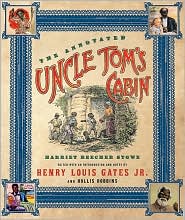
Note: I read an illustrated and annotated version. The 150 black and white illustrations and 32 pages of color artwork are of interest and may be worth the extra expense. The notes and commentary, by Henry Louis Gates Jr. and Hollis Robbins, are trivial and distracting . . . they read as if written by fussy 12-year-olds. If you're considering buying a copy of Uncle Tom's Cabin, skip this annotated version and just buy the real thing.
- Read more banned book reviews at my blog, Paul's Thing


No comments:
Post a Comment